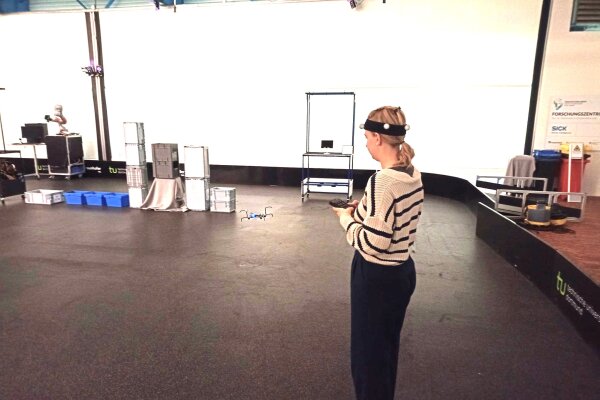
The department of work, organizational, and business psychology at the Ruhr-University Bochum is one of the leading institutes in the field, representing most innovative and successfull degree programms all over germany.
Our main ambition: to become more and more internationally visible in the near future, i. e. more courses in english, more english in final thesis, and more foreign visitors and lectures on a regular basis. This also means an increasing number of projects based on international collaboration with colleagues abroad and within growing exchange of Ph.D. students.
Key aspects in research are psychology of services, social stress at work, and evidence based management.
News and publications
A matter of match?
Van der Tooren, M., de Jonge, J. & Dormann, C. (2012). A matter of match? An experiment on choosing specific job resources in different demanding work situations. ,0International Journal of Stress Management, 19 (4), 311–332.
Abstract:
Though research on the demand-induced strain compensation (DISC) model has suggested that the type of job resources people employ to deal with job demands may have serious implications for job stress theory and practice, not much is known about the choices people make regarding the investment of job resources. The aim of this study is to fill this gap in the literature. In line with the DISC model, we were particularly interested in the extent to which people choose job resources that match job demands (i.e., matching job resources) and job resources that do not match job demands (i.e., nonmatching job resources). For that reason, several vignettes were developed to experimentally examine the extent to which people (92 undergraduates) choose cognitive, emotional, and physical job resources; combinations of these specific job resources; and no job resources at all in different hypothetical demanding work situations (i.e., cognitively, emotionally, and
physically demanding jobs). As predicted, people generally chose cognitive job resources to deal with cognitive job demands, emotional job resources to deal with emotional job demands, and physical job resources to deal with physical job demands. Further, results showed that nonmatching job resources were particularly chosen as a supplement to matching job resources rather than as a substitute for matching job resources. However, in contrast to our predictions, there seemed to be a dominant role for nonmatching cognitive job resources in this respect, whereas nonmatching emotional job resources were chosen less often than expected.
The Role of Partners and Children for Employees’ Psychological Detachment
Hahn, V. C., & Dormann, C. (in press). The Role of Partners and Children for Employees’ Psychological Detachment From Work and Well-Being. Journal of Applied Psychology.
Abstract:
This study examined the role of partners and children for employees’ psychological detachment from work during off-job time. Building on boundary theory, we hypothesized that not only employees’ own work–home segmentation preference, but also their partners’ work–home segmentation preference is associated with employees’ psychological detachment. In addition, partners’ psychological detachment should influence employees’ psychological detachment. We hypothesized that the presence of children in the household moderates partners’ influence on employees’ psychological detachment. Further, we expected both employees’ and their partners’ psychological detachment to contribute to employees’ well-being. Participants were 114 dual-earner couples who responded to web-based questionnaires. The hypotheses were tested with multilevel analyses, using the actor–partner interdependence model. Results largely confirmed our hypotheses. Employees’ and their partners’ work–home segmentation preferences were associated with employees’ psychological detachment. The presence of children moderated the relation between partners’ work–home segmentation preference and employees’ detachment. The relation was weaker when there were children in the household. Moreover, employees’ and their partners’ psychological detachment were positively associated. Again, the relation was weaker when there were children in the household. Finally, both employees’ and their partners’ psychological detachment contributed to employees’ well-being.
Customer-related social stressors
Dudenhöffer, S. & Dormann, C. (in press). Customer-related social stressors and service providers’ affective reactions. Journal of Organizational Behavior.
Abstract:
Previous research has shown that customer-related social stressors (CSS) have negative effects on service providers’ long-term well-being. Little is known, however, about short-term and mid-term affective stress reactions and reciprocal effects between service providers' affect and CSS. The aim of this study is to expand extant research (1) by analyzing service providers’ short-term (across a day) and mid-term (across weeks) affective reactions to perceived CSS, (2) by analyzing intraindividual as well as interindividual effects, and (3) by investigating reciprocal effects of affective reactions and CSS that may eventually lead to psychosocial cycles. Our study employed a diary design with three measurement occasions per day over five consecutive days and a two-week panel design using a sample of employees from public service organizations (N = 106). Results showed that CSS elicit changes in service providers’ short-term and mid-term negative affect. We also found support for reversed effects of service providers’ affective reactions on experienced CSS indicating psychosocial cycles between customers and service providers. To prevent escalation, we discuss potential resources.
Take a break?!
de Jonge, J., Spoor, E., Sonnentag, S., Dormann, C., & van den Tooren, M. (2012). Take a break?! Off-job recovery, job demands, and job resources as predictors of health, active learning, and creativity. European Journal of Work and Organizational Psychology, 21, 321-348.
Abstract:
This study focused on the relation between job demands and two distinct coping resources (i.e., job resources and off-job recovery) in the prediction of psychological outcomes (i.e., active learning, creativity, emotional exhaustion, and physical health complaints). Using the Demand-Induced Strain Compensation (DISC) Model as a theoretical framework, we investigated the issue of ‘optimal resourcing’; that is, the moderating effect of matching job resources and off-job recovery (i.e. detachment from work) on the relation between corresponding job demands and psychological outcomes. Based on a cross-sectional survey study with 399 employees, the overall pattern of regression analyses suggests that matching job resources and off-job recovery are indeed relevant for employees’ outcomes. In conclusion, in order to cope with specific job demands, employees need corresponding job resources as well as off-job recovery to improve their health and job performance.
‚Steuerungswissen‘ für Politik und Praxis für die Qualitätsentwicklung im Bildungswesen
Van Ackeren, I., Zlatkin-Troitschanskaia, O., Binnewies, C., Clausen, M., Dormann, C. Preisendörffer, P., Rosenbusch, C., & Schmidt, U. (2011). Evidenzbasierte Schulentwicklung. Die Deutsche Schule, 103, 170-184.
Abstract:
Das Konzept der Evidenzbasierung von Steuerung und professionellem Handeln erfährt im Bildungswesen zunehmende Beachtung. Im Kern geht es darum, empirisch hinreichend belegte Erkenntnisse als ‚Steuerungswissen‘ für Politik und Praxis für die Qualitätsentwicklung nutzbar zu machen. Wie erste Befunde aus unterschiedlichen Forschungsdisziplinen jedoch zeigen, lassen sich empirische Erkenntnisse nicht umstandslos in erfolgreiches ‚evidenzbasiertes‘ Handeln umsetzen. In diesem Zusammenhang wird eine systematische Bestandsaufnahme des nationalen und internationalen Forschungsstands geleistet.
1. Internationaler Forschungstag AOW
Die Freude war gross: Zum 1. Internationalen Forschungstag AOW am 10.7.2012 in Bochum konnte Herr Dormann nicht nur den renommierten Arbeits- und Organisationspsychologen Dieter Zapf (Johann Wolfgang Goethe-Universität, Frankfurt/M.) gewinnen, sondern auch Maureen Dollard aus Adelaide, Australien, sowie Zhaoli Song aus Singapur.
Während Herr Song zum Thema "Start-of-day Recovery, Momentary Stressor and Momentary Affect" vortrug, behandelte Frau Dollard "The origins of Work Stress".
Auch der Vortrag von Dieter Zapf zum Thema "Bullying/Mobbing at Work: Empirical Findings and Implications for Prevention and Intervention" wurde - auch in englischer Sprache - rege diskutiert. Fortsetzung folgt.
Psychosocial safety climate
Law, R., Dollard, M.F., Tuckey, M.R., & Dormann, C. (2011). Psychosocial safety climate as a lead indicator of workplace bullying and harassment, job resources, psychological health and employee engagement. Accident Analysis & Prevention, 43, 1782–1793.
Abstract:
Psychosocial safety climate (PSC) is defined as shared perceptions of organizational policies, practices and procedures for the protection of worker psychological health and safety, that stem largely from management practices. PSC theory extends the Job Demands-Resources (JD-R) framework and proposes that organizational level PSC determines work conditions and subsequently, psychological health problems and work engagement. Our sample was derived from the Australian Workplace Barometer project and comprised 30 organizations, and 220 employees. As expected, hierarchical linear modeling showed that organizational PSC was negatively associated with workplace bullying and harassment (demands) and in turn psychological health problems (health impairment path). PSC was also positively associated to work rewards (resources) and in turn work engagement (motivational path). Accordingly, we found that PSC triggered both the health impairment and motivational pathways, thus justifying extending the JD-R model in a multilevel way. Further we found that PSC, as an organization-based resource, moderated the positive relationship between bullying/harassment and psychological health problems, and the negative relationship between bullying/harassment and engagement. The findings provide evidence for a multilevel model of PSC as a lead indicator of workplace psychosocial hazards (high demands, low resources), psychological health and employee engagement, and as a potential moderator of psychosocial hazard effects. PSC is therefore an efficient target for primary and secondary intervention.
Objective work–nonwork conflict
Haun, S., Steinmetz, H., & Dormann, C. (2011). Objective work–nonwork conflict: From incompatible demands to decreased work role performance. Journal of Vocational Behavior, 79, 578-587. doi:10.1016/j.jvb.2011.05.001
Abstract:
Research on work–nonwork conflict (WNC) is based on the assumption that incompatible demands from the work and the nonwork domain hamper role performance. This assumption implies that role demands from both domains interact in predicting role performance, but research has been largely limited to main effects. In this multi-source study, we analyze the incompatibility of demands by testing the interaction of work and nonwork demands on task performance and organizational citizenship behavior (OCB). The sample consisted of 61 employees of a German hospital and we used three independent sources of data: self-ratings of work demands, partner-ratings of nonwork demands, and colleague-ratings of performance. Results from hierarchical regression analyses revealed an interaction effect of work and nonwork demands on OCB, but not on task performance. We conclude that people maintain their effort invested in task-related aspects of the job even when conflicts between work and nonwork demands exist, but that they reduce their investment in activities that are perceived as more marginal and extra-role.
Conceptual distinctiveness and effect on job demands
Idris, M. A., Dollard, M. F., Coward, J, & Dormann, C. (2012). Psychosocial safety climate: Conceptual distinctiveness and effect on job demands and worker psychological health. Safety Science, 50 (1), 19-29.
Abstract:
Psychosocial safety climate is an emerging construct that refers to shared perceptions regarding policies, practices, and procedures for the protection of worker psychological health and safety. The purpose of the research was to: (1) demonstrate that psychosocial safety climate is a construct distinct from related climate measures (i.e., physical safety climate, team psychological safety, and perceived organizational support); and (2) test the proposition that organizational psychosocial safety climate determines work conditions (i.e., job demands) and subsequently worker psychological health. We used samples from two different cultures; an Australian sample ( N = 126 workers in 16 teams within a primary health care organization) and a Malaysian sample ( N = 180 workers in 31 teams from different organizations and diverse industries). In both samples confirmatory factor analysis verified that psychosocial safety climate is a construct distinct from related climate measures. Using hierarchical linear modeling, psychosocial safety climate was superior to other team level climate measures in its negative relationship to both job demands and psychological health problems. Results supported a mediation process, psychosocial safety climate → job demands → psychological health problems, corroborating psychosocial safety climate as a preeminent stress risk factor, and an efficient target for intervention. We found both physical and psychosocial safety climates were stronger in the Australian, compared with the Malaysian work context. Levels of psychosocial safety climate were significantly lower than those of physical safety climate in both countries indicating a ‘universal’ lack of attention to workplace psychological health.
Psychosocial safety climate moderates the demand-resource interaction
Dollard, M.F., Tuckey, M.R., & Dormann, C. (2012). Psychosocial safety climate moderates the demand-resource interaction in predicting work stress. Accident Analysis & Prevention, 45, 694-704
Abstract:
Psychosocial safety climate (PSC) arises from workplace policies, practices, and procedures for the protection of worker psychological health and safety that are largely driven by management. Many work stress theories are based on the fundamental interaction hypothesis—that a high level of job demands (D) will lead to psychological distress and that this relationship will be offset when there are high job resources (R). However we proposed that this interaction really depends on the organizational context; in particular high levels of psychosocial safety climate will enable the safe utilization of resources to reduce demands. The study sample consisted of police constables from 23 police units (stations) with longitudinal survey responses at two time points separated by 14 months (Time 1, N = 319, Time 2, N = 139). We used hierarchical linear modeling to assess the effect of the proposed three-way interaction term (PSC × D × R) on change in workgroup distress variance over time. Specifically we confirmed the interaction between emotional demands and emotional resources (assessed at the individual level), in the context of unit psychosocial safety climate (aggregated individual data). As predicted, high emotional resources moderated the positive relationship between emotional demands and change in workgroup distress but only when there were high levels of unit psychosocial safety climate. Results were confirmed using a split-sample analysis. Results support psychosocial safety climate as a property of the organization and a target for higher order controls for reducing work stress. The ‘right’ climate enables resources to do their job.
On the positive aspects of customers
Barbara K. Zimmermann, Christian Dormann and Maureen F. Dollard (2011). On the positive aspects of customers: Customer-initiated support and affective crossover in employee-customer dyads. Journal of Occupational and Organizational Psychology, 84, 31–57.
Abstract:
This study investigated affective linkages in customer-service dyads as well as main and mediating effects of positive customer behaviour (customer-initiated support). We examined affective crossover of customer and service employees and focused on customer-initiated support as a resource for service employees. State positive affect (PA) was assessed in 82 car dealership employees and 421 customers on 2 occasions (before and after conversation). Hierarchical linear models showed crossover effects of employees’ PA on customers’ PA. Furthermore, customer-initiated support enhanced employees’ PA and indirectly linked customers’ and employees’ PA. Results are integrated in an overall model: Customers’ PA enhances customer-initiated support, which establishes employees’ PA, which in turn enhances customers’ PA. Implications for further research and practice are given.
Psychosocial safety climate buffers effects of job demands on depression
Hall, G. B., Dollard, M. F., Winefield, A., Bakker, A. & Dormann, C. (in press). Psychosocial safety climate buffers effects of job demands on depression and positive organizational behaviours. Anxiety Stress & Coping.
Abstract:
In a general population sample of 2343 Australian workers from a wide ranging employment demographic, we extended research testing the buffering role of psychosocial safety climate (PSC) as a macro-level resource within the health impairment process of the Job Demands-Resources (JD-R) model. Moderated structural equation modelling was used to test PSC as a moderator between emotional and psychological job demands with worker depression as the outcome compared with control and social support as alternative moderators. We also tested PSC as a moderator between depression and positive organizational behaviours (POB; engagement and job satisfaction) as the outcome compared with control and social support as moderators. As expected we found PSC moderated the effects of job demands on depression and further moderated the effects of depression on POB with fit to the data that was as good as control and social support as moderators. This study has shown that PSC is a macro-level resource and safety signal for workers acting to reduce demand-induced depression. We conclude that organizations need to focus on the development of a robust PSC that will operate to buffer the effects of workplace psychosocial hazards and to build environments conducive to worker psychological health and positive organizational behaviours.